-
About West Bengal...
The first great dynasty to rule over West Bengal were Palas who ruled till the 9th century AD. In the 7th century AD,Adimalla founded the Malla dynasty, and ruled for over a thousand years in areas of western Bengal. The Mallas built some spectacular temples in Vishnupur,their capital. In the 16th century,European traders established their trading factories in India and were attracted to Bengal but themost successful were English East India Company. In 1690,they established a factory at Sutanati,which later became modern Calcutta. In the 18th century the last independent Nawab of Bengal called Siraj ud Daulah lost to the British in the year 1757. In 1765,the British obtained the right to collect revenue from Bengal,Orissa and Bihar. In the late 19th century,
Calcutta now called Kolkata became a major centre for the Indian nationalist movement. In 1905,Bengal was partitioned,to control the growing nationalist movement. But this led to huge protests,boycott of British goods and terrorist activities and in 1911,King George V revoked the partition. In 1947 after independence,Bengal was partitioned and its western half became the present state of West Bengal. West Bengal has a tropical climate. The plains are hot except during the short winter season. The mountanious region in the north is cold. Humidity is high because of the altitude. There are vaguely six seasons - Spring,Summer,the rainy,Autumn,mild Winter and severe Winter. The hot season lasts from mid-March to mid-June,with the day temperature ranging from 38o C to 45 C in different parts of the state. Winter lasts about three months,is mild over the plains,the average minimum temperature not falling 15 C.
Places To Visit...
Calcutta
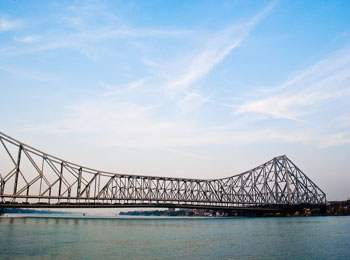
Grown from mangrove swamps, Calcutta is the largest metropolis in India. Calcutta's role in the national economy is of crucial importance as the Gateway to Eastern India. Ships were the beginning of Calcutta's history & the river Hoogly was the key to the city's fortunes. Vishnupur is famous for the exquisite 17th & 18th century terracotta temples, Seat of classical music. The Stylized, "Bankura horse" symbolic of excellence in rural handicrafts is native to this district. Belur Math is a modern temple within the grounds of the Ramakrishna Mission. Dakshineshwar Temple, dedicated to Kali is built in the architectural style of Bengal.
Sunderbans
The biggest colony of the `Royal Bengal Tigers' - the Sundarbans. These evergreen mangrove forests pulsate with a myriad forms of life. Above the Kingfisher and White-bellied Sea eagle add a brilliant burst of colour. The sea creeps in at high tide. The ebbing waters reveal nature so alive on the glistening mud flats. The land is split by numerous rivers and water channels all emptying into the Bay of Bengal. It is believed that Bonbibi, the goddess of the forest, protects the wood-cutters, honey-collectors and fishermen on their hazardous missions. For, as the saying goes, `Here the Tiger is always watching you'. Some people, believe that they could," however, have got their name from the profusion of Sundari trees. Some wild creatures are spotted deer, boar, monkey, crocodile, python, Salvatore lizards, and a wide range of water birds.
Jaldapara Sanctuary
Jaldapara Wild Life Sanctuary situated in Alipurduar Sub-Division of Jalpaiguri district in West Bengal was constituted in the year of 1941 for the protection of wild life, particularly single horned Rhinos. River Torsha runs through this river rain forest sanctuary which is mostly covered with tall grasses. The wild life, in addition to the famous single horned rhinos, consists of Royal Bengal Tigers, wild elephants, deers, swamp deers, hog deers, wild pigs, bisons and a number of birds, pea-fowl etc.
Bakkhali
The second popular sea resort of West Bengal is Bakkhali , situated only 132 kms away from Calcutta , It is quiet and charming.
Shantiniketan
Shantiniketan is an International University founded by Nobel Laureate Rabindranath Tagore where the cultures of the East & the West could meet and mingle. Named Vishva-Bharati, the University represents Indian traditions while incorporating the best of other cultures. Shantiniketan, the abode of peace, was initially an Ashram or hermitage founded in 1863 by Maharishi Devendranath Tagore. In 1901 his son, Rabindranath converted it into an experimental open-air school with just five students. He widened the scope of studies which gradually formed the nucleus of a University. Another interesting feature about Santiniketan is that splendid sculptures, frescoes, murals and paintings of Rabindranath, Nandlal Bose, Ramkinkar, Bindobehari Mukhopadhyaya and others adorn the campus.
Vishnupur
Terracotta, metal ware & temples characterise Vishnupur. The temples are built mostly of brick & at times, of laterite. Clay & laterite are the only building materials available here besides wood and bamboo. The architecture is modeled on the pattern of Bengali huts built of bamboo & mud and roofed with thatch. Vishnupur will remain ever famous for its distinct style of music, i.e. the Vishnupur Gharana, if not anything else. The name of Jadu Bhatt, the music teacher to Rabindranath Tagore, is remembered with respect to this day. A discerning visitor may find traces of the past splendour and glory that was Vishnupur in its superb temples and unique handicrafts.
Darjeeling
Darjeeling is nested in a setting of Kanchenjunga and Mount Everest, Tibetan Monasteries, Himalayan Tribal Life, Pine Trees etc. Which make her qualify as the queen of the hill stations.
Sagardwip (Sagar Island):
Gangasagar Mela, the largest fair in west Bengal held near the confluence of the Ganga and the Bay of Bengal, draws millions of pilgrims from all over India. They come for a holy dip on Makar Sankranti (last day of the Bengali Month) and after their obligations at the Kapilmuni Temple nearby.
Raijang Bird Sanctuary
Altitude: 30 meters above sea level. Temperature (deg C): Summer- Max. 25, Min. 21. Winter- Max. 23, Min. 09. Rainfall: 155 cms (July to September). Clothing: Summer- Cottons, Tropical. Winter- Woolens. Languages spoken: Bengali, Hindi, English. Best season: Throughout the year but preferably October to March.
Plassey
A place of great historical importance. Here in the year 1757 a battle was fought between the British and the last Nawab of Bengal, Bihar and Orissa. Clive the British Chief defeated Nawab - Siraj-ud-daula by unfair means. Siraj-ud-dula was killed and Mirzaffar became the Nawab. The historic battle field is till preserved. A memorial was erected by Lord Curzon at the mango groves where the actual battle took place.
Kurseong:
Kurseong is mid-way between Siliguri and Darjeeling. The way from Darjeeling to Kurseong is generally open through out the year. So, the toy train is not coming to Siliguri then one can come up to Kurseong. This place is equally beautiful and is full of natural splendour.
Kalimpong:
Just 51 kms east of Darjeeling is situated the picturesque town of Kalimpong, the former headquarters of the Bhutanese Governor. Situated at an altitude of 1250 meters between the Deolo and Durbindra Hills, Kalimpong is an ideal place for a quiet holiday amidst gently rolling hills and deep valleys at the foot of the mighty Himalayas.
Durgapur:
Durgapur projects an image of an industrialized India. It is the third integrated steel plant of Hindustan Steel Limited and occupies an area of 6.47 sq. kms. Founded under the Colombo Plan Mission which visited India in April, 1955, the plant has been instrumental in changing the rural face of Durgapur into a vast industrial complex comprising public and private sectors.
Digha
Beach-on-the-bay of West Bengal, Digha, has the whispery, languid, soft-focus, charm which is so graciously bengali : sighing casuarinas, ponies nodding on the beach, prolonged meals in the flavorsome sweet-&-salt idiom of the state and timeless days and nights of nothing to do but unwind and find yourself.
Buxa Tiger Reserve
Buxa Tiger Reserve was set up in the year of 1982-83 at the north eastern corner. This picturesque reserve with its proigous Terai, Bhabar as well as Hilly landscape, is dissected by numerous rivulets. The varitable flora and fauna of these wet forests attracts tourists and nature lovers every year. This part of the country is characterized by its high degree of plant & animal bio-diversity where 60% species are endemic to the area. The Generic diversity of mammals is second highest among all the tiger reserves of India. Astonishing bio-diversity of animals comprise of a reach avifauna of more than 230 identified species, 67 mammals (out of which 21 are endangered), 36 species of reptiles (10 numbers are endangered). Apart from Bengal Tiger there are plenty of Leopard, Fishing Cat, Leopard Cat, Jungle Cat, Indian Civet, Palm Civet etc. The Hornbills including greater Pied Hornbill abound the area. One of the rarest bird of India the Black-necked Crane has been sighted in the Reserve during the early winter. The migratory beautiful Black Stork is a visitor of the area. The monsoon ends and beautiful Minivets, Sultan tits arrive, during summer rare Ashyminivet is also sighted.
- .