-
About Sikkim...
The beautiful hill state of Sikkim lies on the eatern tip of the Himalayas bordered by Bhutan, Nepal an Tibet. Sikkim is famous for Kanch-Endzonga, at 598 mtrs, which is third highest mountain in the world. Being second smallest state in India, Sikkim covers 7,096 sq kms and measures 110 kms from north to south and 64 kms from east to west. It encompasses the upper valley of Teesta river, a tributary of the Brahmaputra. The watershed form the borders with Tibet and Nepal. Rangit and Rangpo rivers form the border with West Bengal. Sikkim is separated from Nepal in the west by the Singalila range while Donngkya range is the border to the north & north-east.
Sikkim is broadly divided into four districts. The east district with capital city of Gangtok is the hub of all administrative activity. The famous Rumtek Monastery, the Dharma Chakra Centre and the seat of his Holliness Gyalwa Karmapa, all are located here. Other places of interest include the Tsomgo Lake and the Nathula Pass. A most beautiful district, the North District is an abundance of the natural splendour and Alpine scenery. During spring time, the meadows are alive with exotic wild flowers that cover the valley in charming hues. The hot springs and tribal customs & culture here are very attractive. The west district offers the ultimate in adventure. From white water rafting on the foaming Teesta and Rangit, to trekking through thick Rhododendron forests- the district offers it all. A breathtaking view of Mt Kanch-Endzonga can be had from Pelling that has developed as a major tourist attraction. The sacred lake of Khechiperi also lies close to Pelling. The Osuth District is home to some of the oldest monasteries in the state. Adventure treks to Maenam and Tengdong Hill originate from Rawangla. The region is also just-right for mountain biking and nature watching.
Places To Visit...
Phodong Monastery:
One of the six major monasteries in Sikkim, Phodong monastery is located in the North approximately 38 kms from Gangtok, 4 kms beyond Phodong is the recently renovated Labrang Monastery unique in it architectural design.
Phensang Monastery:
This monastery is situated on the gentle slope stretching from Kabi to Phodong with perhaps one of the best landscapes in the region. The Phensang Monastery, under the Nyingmapa Buddhist Order, was built in 1721 during the time of Jigme Pawo. It was gutted by fire in 1947 and rebuilt in 1948 hrough the efforts of the lamas. The annual festival of Chaam is performed on the 29th and 29th days of the tenth month of the Lunar calendar (Tibetan Calendar).
Singhik:
The place offers one of the most spectacular and closest views of Mt. Kanchenjunga and its ranges. A well located Tourist Lodge provides accomodation for visitors. The area also has a number of interesting short nature trails for 1 to 3 days along the higher ridges of the higher ridges of the surrounding hills. One can also savour the most graceful peak in the world, Mt. Siniolchu.
Chungthang:
Chungtnahg, on the confluence of Lachen and Lachung Chu and the starting point of River Teesta, has emerged as a major sub-division settlement in North Sikkim. It is the nodal junction for the two passes, Lachen and Lachung. The valley is believed to have been blessed by Guru Rimpoche and one can visit the Holy Guru Lhedo to see the foot and palm prints left behind by the Patron Saint. The place is rich in bio diversity with a large variety of orchids, plants and wildlife, is 95 kms from Gangtok, 23 kms from Lachung, 29 kms from Lachen and is predominantly a Lepcha region.
Lachung:
A Bhutia village with a unique loacl self-governing body called the Zumsa which substitutes the Panchayat. Lachung has emerged as a tourist destination with the soaring popularity of Yumthang Valley which is just 25 kms from Lachung. The village, spreads out on either side of Lachung Chu, has managed to retain its unique culture and tradition. The Lachung Monsatery on the slope opposite to the highway is a focal point of all religious function of the local inhabitants. To get a glimpse of the religious functions performed on auspicious occasion a visit to the Monastery should form part of the tour itinerary.
Yumthang:
Yumthang, at an elevation of 11,800 ft and 140 kms from gangtok is a paradise for nature lovers with a fascinating blend of flora and fauna and breathtaking scenic granddeur. The valley is also the home of Singbha Rhododendron Sanctary with 24 species of Rhododendrons. Yumthang 'Tsa-Chu' or the hot spring of the left bank of Lachung Chu is immensely popular for its curative properties and healing power.
Lachen:
Lachen is situated at an altitude of 2750 mtrs. and about 6 hrs. drive from Gangtok. The Lachen Monastery Located on top of the village commands a panoramic view of the surrounding hills and country side. Resorts, hotels and lodges are available for accomodation.
Guru-Dongmar Lake:
Guru-dongmar lake is considered as one of the sacred lakes of this State both by the Buddhist and the Hindus. The lake remains milky in color throughout and it is believed the Guru Padmasambhava had touched the lake whilst he visited Tibet from this area. - Namchi :
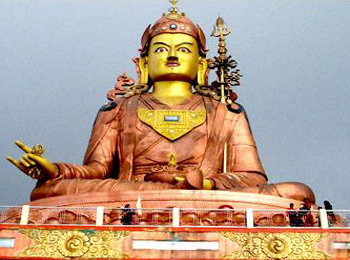
Namchi, meaning 'Sky High', nestled among the hills at an elevation of 5,500 ft commands panoramic view of the snow-capped mountains and vast stretches of valley. Atop Samdruptse hilltop near Namchi, recently erected is the worlds tallest statue of Guru Padmasambhava, the patron saint of both Hindus and the Buddhist.
Temi Tea Garden:
The one and only tea garden existing in the State produces one of the top quality teas in the international market. The tea garden is spread out on a gently hill slope originating from the Tendong Hill and provides a magnificent view for the surrounding villages. The visit to the factory could be an eye opener for those wanting to know more about tea processing methods.
Ravangla:
At the base of Menam Hill is Ravangla, a small township and transit to various tourist destinations in South and West Sikkim. It is also an upcoming tourist spot, and transit point for trekkers to Menam hill and Borong. There are accomodation facilities and numerous short nature trails. A trek down to the sacred cave 'Sher Chok Bephu', one of the four holiest caves in Sikkim, would be a memorable experiance.
Menam Hill:
Menam Hill towers above Tendong Hill on the other side over looking the ravangla Bazar settlement. Situated at an altitude of 10,300 ft the scenic view from this height is, perhaps, unmatched in this part of the world. Mt. Khangchendzonga and its surrounding ranges looms above the dwarf the richly forested and rugged hill. On a clear sunny day, it is possible to see the plains of Bengal spanning across Kalimpong and Darjeeling Hills in the South, right across the Indo-China border towards the North. A short distance away is the legendary Bhaley Bhunga, a kind of rocky spur which juts out from the ridge top and remains suspended in the air above Yangang village.
Borong:
Facing the snow-capped mountains is Borong, motorable from Ravangla or a trek via Menam. A picturesque village, its beautiful landscape and magnificent view is also host to the hot spring, Borong TsaChu'. The trek trail, originating from Namchi or Damthang to Tendong - Ravangla - Menam - Borong (5-6 days) is one of the most interesting trails scaling all the hill tops along the route. The trek can continue to Tashiding or terminate at Borong and drive back to Ravangla.